We may earn a commission when you buy through links on this page, at no extra cost to you. How that works.
Luxi vs. Casper: The Perfect Mattress?
More features, technology and design for adaptability by Luxi makes the comparison of Luxi and Casper mattresses difficult. The same can most likely be said for the comparison of Luxi to any number of the other Casper alternative or “Casper Class” mattresses that I have reviewed.
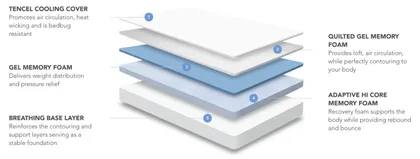
Many of the Casper Class mattresses (focusing on those introduced in the wake of Casper’s launch about two years ago) are built in a similar fashion. They are based on multiple foam layers, with at least three total layers of foam, with at least two of the layers comprised of “higher technology materials, such as memory foam, gel or metal-infused foams or Latex, covered by an internal fire barrier for safety regulation compliance and then an elastic, knitted outer cover.
The outer cover usually zippers into position, creating the desired esthetics and an overall load bearing that allows the comfort and support characteristics of the foam interior to be translated to the sleeper with a minimum of “hammocking” or other distortions. Casper and these ”followers” are also similarly assembled and marketed; compression packaged for home delivery, roughly priced at the same level and delivered with free shipping and free return trial periods. Certain elements of my comparison of Luxi and Casper are shared by many of the other mattresses that I have reviewed on this website previously.
A queen Luxi costs $999 but routinely carries a manufacturer’s discount of $50 to $100, so after using my discount code, getting you an additional $100 discount, Luxi is effectively priced in the range of $799 to $849, or right at the list price of a Casper. The standing manufacturer’s discount may be Luxi’s way of communicating that they are the mattress manufacturer, not a marketing company or product reseller. Casper and most of the Casper alternative mattresses are not provided directly by the manufacturer. A point worth noting because, if you’re not the manfacturer, details like quality control can become problematic.
The majority of the Casper Class mattress are priced in the range of $650 to $999 so, Luxi is priced in the middle of the range and certainly not out of line with the value proposition it provides, if for no other reason than its the only adjustable three-in-one mattress I’ve have reviewed to date.
As Luxi’s marketing materials state, with respect their design intent, if every other consideration for the ideal sleep environment (bedroom) is adjustable and therefore adaptable to a wide range of consumer preferences, such as temperature, air velocity and direction, lighting, sound, aroma, etc., then why is it that the mattress is the only object in the room that isn’t adjustable? Good question.
TOP COVER
Casper:
Premium textiles from the USA and Belgium. Hand-sewn in South Carolina and Illinois. The cover is not removable and not washable. The cover is zippered into position as a manufacturing closing technique, and it is not intended that the cover be removed for laundering,
Luxi:
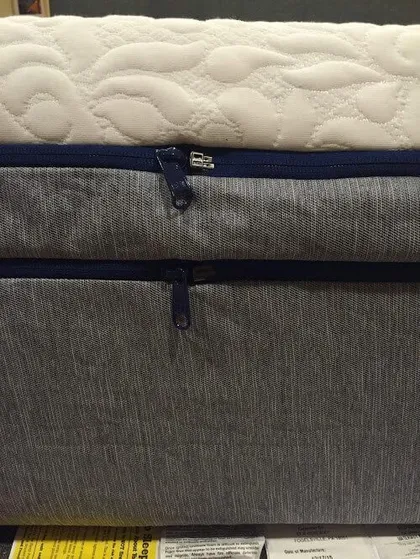
Premium textiles from the USA. Hand-sewn in California. The outer cover is a complex construction comprised of a top and bottom half. One key design feature is that the outer cover zippers open to allow access to the interior foam cores and inserts for the purpose of rearranging them. Like Casper, the cover is not zippered so it can be cleaned. The cleaning instructions suggest proper care and spot cleaning rather than laundering. The top half and sleep surface of Luxi’s outer cover is a stretch premium polyester knit quilted together with a lite backing similar to the sportswear fabric of Under Armor that sandwiches a thin layer of foam, which provides loft, and a layer of Dacron fiber fill that provides additional loft and also serves as a flame barrier. The benefits of the design of the quilted cover are many. It is crafted from stretch knit and Lycra materials so the feeling of the foam interior is not lost, and it also serves three other key objectives:
- The flame protection is built into the cover so it doesn’t interfere with access to the adjustable inserts inside the mattress.
- The integrity of the outer cover conceals and bridges the separation space between the right and left hand sides of the mattress which can’t be felt.
- Recognizing that the consumer may open the Luxi from time to time to make adjustments, the cover is configured into a lower half (a tub) and an upper top cover (a cap) that have enough rigidity, so that everything looks sharp and tailored when reassembled.
The lower half of the outer cover is made from a furniture-grade woven fabric that has flame protection material laminated to its backside. Further evidence of Luxi’s concern for flame safety is evidenced by the flame barrier flap behind the zipper and the use of a specific grade of flame resistant, non-skid bottom surface fabric.
Winner:
Luxi. The cover is noticeably higher quality and the quilted top surface protects the style and integrity of the mattress while allowing access to the interior, and it is an extremely cool and compliant surface.
TOP INSIDE LAYER
Casper:
1.5″ Latex foam with medium springiness. The use of this type of Latex on the upper most surface of the mattress core results in a relative medium firmness feel that is springy. It also addresses a concern shared by many that sleeping directly on memory foam is hot. Whether or not one believes new open cell memory foam or foams infused with heat conducting fillers like gel work to keep things cool, one sure way of addressing this issue is to put the Latex layer on top. A more traditional design to enhance the softness of a mattress top surface would call for putting the memory foam on top and the firmer Dunlop Latex underneath it.
Luxi:
Luxi is an adjustable mattress, and the creation of different “feels” of soft, medium and firm is accomplished by rearranging the interior foam components. The total foam interior is made up of a conventional urethane foam core and a separately covered insert that is comprised of three individual layers including Latex, memory foam and a proprietary SBT (support balancing technology) foam layer. The different feels are accomplished by restacking these elements. The insert is flipped to one side or another for the soft and medium settings and the core element is brought all the way up to the top surface for the diehards that like sleeping on a plank.
For the sake of this comparison I’m accessing the Luxi in its softest setting. I am also considering the top two elements in the Luxi insert (the SBT element and the memory foam layer beneath it) to be the top layer for the sake of the following write up.
The inserts are separately covered in a Lycra fabric to make them more durable and easier to handle. They are loaded with Latex material and therefore are pretty heavy. The mattress interior core pieces are all split separating the right and left sides on all queen and king sizes so that each sleeper can create his or her individual softness setting.
For this comparison, Luxi’s top layer in the softest setting, which Luxi says is the most popular setting, is made up of two separate foams. The uppermost and first layer perceived by the sleeper is a fabricated foam element that is more firm than memory foam, but because of the shapes fabricated into the foam it tends to feel like an enhanced memory foam. What happens is that the shapes collapse when the slightest load is exerted on them, offering up only slight resistance as memory foam does, and then as soon as that occurs the sleeper begins to feel the support from the flat memory foam directly beneath it. So there is a clear “in it” rather then “on it” feeling conveyed by the SBT layer.
The SBT layer is 4-pound density, enhanced urethane foam. The memory directly beneath it is also 4-pound density memory foam. The SBT element is 3.5 inches thick. The memory foam beneath it is 1.25 inches think.
If you prefer more bounce and a firmer feel, Casper would be a better option. Both Luxi and Casper have effective airflow channels; however, the airflow channels in Casper run vertically and result from the removal of no more than 13% of the total product. The airflow created in the Luxi soft surface configuration results from the net removal of almost 20% of the material in that layer, and therefore produces a larger opening, but more significantly, the resulting airflow channels run in a horizontal direction. The problem with the vertical orientation of the Casper airways is that they allow air to get trapped between the sleeper and the underlying materials. In Luxi the air movement is forced laterally and it escapes from under the sleeper, convecting heat away.
Winner:
If you want more options once you receive your mattress, Luxi wins. If you are comfortable accepting that one-size-fits-all concept, Casper wins.
Middle Layer
Casper: 1.5″ 4 lbs./cu.ft. memory foam.
Luxi: 1.5″ Latex foam with medium springiness. Exactly the same material as in the top layer of the Casper mattress.
Winner: See previous assessment.
BASE LAYER
Casper: 6.5″ conventional polyurethane foam in the 1.9 lbs./cu.ft. range.
Luxi: 3.5″ conventional polyurethane foam in the 1.9 lbs./cu.ft. range.
This is higher-than-average density for a base layer and both mattresses fare about the same. The issue might rather be the amount of each of these foams (some light, some heavy) inside of the mattress and the impact of that can be measured by comparing the physical weights of the mattress.
A Luxi queen weighs 83 lbs. and the Casper queen weighs 71 lbs.
Concerning the breakdown between conventional forms and higher technology materials the breakdown between Luxi and Casper is as follows:
Mattress Construction Element Materials In Inches (not arranged in their build order)
Inches Of Mattress Thickness
Luxi Casper
Higher SBT 3.50
Technology 4.0 lbs/cu.ft.
Materials SBT Foam
4.0 lbs./cu.ft. 1.25 1.50
Memory foam
Dunlop Continuous 1.50 1.50
Latex Process Latex
___________________________________________________________
Conventional 1.9 lbs./cu.ft. 3.50 6.50
Poly Base Polyurethane
Total Higher Technology Materials:
Luxi 6.25 inches
Casper 3.00 Inches
Winner: Luxi, not because it necessarily feels better in any one softness setting, but because it delivers more higher density foam in the form of the higher technology materials and so it will last substantially longer before developing impressions. The higher total weight reflects the difference in the amount of polyurethane foam in the base compared with the higher technology foams above the base. There are more higher technology materials in Luxi. A lot more. Three inches in Casper and 6.25 inches in Luxi. Both mattresses are nominally 10 inches in thickness. But the Luxi has more material in the upper high technology layers, and Casper has a larger conventional urethane base.
Other Considerations
BOUNCE: Luxi is committed to the benefits of memory foam and Latex working well together, and so is Casper. If you’re looking for the slow deforming traditional memory foam feel, like the feel of a traditional Tempurpedic mattress, you’ll not find this in either Luxi or Casper.
The Casper is the springiest compared to Luxi when Luxi is in its softest setting – that comes the closest to delivering some of that traditional memory foam feel. But in its medium setting Luxi and Casper feel very similar. This is not surprising as the layer of Latex that in the uppermost or top surface position when you have Luxi in its medium setting is precisely the same Latex layer, and in the same thickness as in a Casper.
OFF-GASSING: All foam mattresses “off gas,” and without regard for the chemistry that is the source of this concern, one of the biggest determinants to experiencing “off gassing” and odor is the time the manufacturer allows for the newly created foams to cure before they are fabricated and hermetically sealed in their final airtight packaging. Another consideration is the time the mattress will take to lose the “new car smell” that is inherently present and a good analogy for the phenomenon. Bottom line, Luxi and Casper are constructed of precisely the same materials except for Luxi’s SBT (support balancing technology) layer. So it’s reasonable to expect about the same off gassing experience. But the SBT layer in Luxi, reasonably, because of its very open and disconnected physical configuration, serves to allow for a quick dissipation of any lingering smells. With wide-open airways as opposed to flat, glued together layers, there is a logical expectation that a little movement would help speed things along to air out any perceptible odor in the Luxi very quickly. So Luxi may have a theoretical advantage concerning off gassing, which difference I have not observed.
Customer service: Both have an excellent customer service track record. You have to be right there at the same time of opening camparable mattresses and that is something I have not yet perfected.
DELIVERY: Both offer fast, free delivery. Casper offers three to five day delivery and faster delivery in New York City, so it gets the huge edge here. Luxi is located on the West Coast, is hand crafted and made to order and ships with three to five days. Delivery may require additional time depending on your location.
RETURN POLICY: Both Luxi and Casper offer 100 nights and Luxi takes their customer service one step further than the rest of the Casper Class retailers, with a 1,000 Night Pledge. Think of it as a 100 night trial but it lasts longer. Which means at any time during the first 1,000 nights, one of the company’s sleep specialists is available help customers resolve issues.
WARRANTY: Both Luxi and Casper offer 10 years.
THE FINAL VERDICT:
Luxi is the overall winner, owing to its physical flexibility and three-in-one construction.
Casper has been leading the way in this new online segment for the past couple of years with a simple mattress that is effective in its construction and very well suited for a majority of the individuals in its target market. The purchasing experience has also been simplified and the risk of not liking the mattress reduced by a very consumer centric trial and return policy. The performance of the Casper has been proven and Casper is recognized as a reliable and adequate mattress for most.
LUXI, on the other hand, makes me think about consumer electronics products where the introduction of the next technology level product, obsolete everything before it. That makes marketing at one technology level difficult after the introduction of the next. Imagine how hard marketing the iPhone4 became after the introduction of the iPhone6 with its added features and functions at essentially the same price. LUXI is certainly leading a new wave of higher order mattress constructions online and doing that at roughly the same price.
The simplest task of the mattress is to deliver a reliable, good night’s sleep. If one’s preferences line up, both Luxi and Casper are great products. They are certainly a more than adequate alternatives to the in store memory foam mattress selections offered by the big brands, but if you consider yourself an early adapter or like to experiment with the environment you live in, then Luxi is the clear choice. In fact, I’d say: “Luxi is a harbinger of things to come for the online mattress consumer.”
Both Luxi and Casper offer generous trial and return policies. So, if you think you made the wrong choice, then you can always get your money back easily and order the other mattress for comparison.
While Casper popularized the one-size-fits-all Latex/memory hybrid mattress, and it has attracted many competitors over the last couple of years, Luxi is one of the few high-end performance mattresses online that can be compressed and delivered to your home, and it has received one of my highest reviews.
Luxi is a Sleep On It Now Top Pick.